
GitHub's brand is cracking
Plus, a Monet that wasn't AI, Design Engineering's moment and a new "Field Notes" section

One way to view a brand is simply as a promise, delivered consistently over time.
GitHub's brand promise is that they're the place code lives, reliable, always on.
What happens when internal politics, corporate malaise and complacency erode that promise?
- Mon
.
.
.
State of the Craft: 85.51%. That's GitHub's platform uptime over the last 3 months. The industry standard is 99.9%.

GitHub Has a Brand Problem, Not a Design One
GitHub is an interesting example of how Design and Brand are different (despite their many overlaps). GitHub has good design, the Octocat logo is iconic, a brand refresh and continued collaborations with BUCK over the years have created an exciting and dynamic visual language.
But GitHub doesn’t have a design problem right now, but more a brand one. When GitHub goes down, so does shipping code at thousands of companies. GitHub's brand promise is that they're the place code lives, reliable, always on, the bedrock layer.
A downtime page GitHub intentionally hides (but a third party tracks) reveals their uptime woes. Having part of your service down 15% of the time is… kinda shit. April piled on: a critical vulnerability flagged by Wiz, and merges reverted across hundreds of repos. The frustration is palpable, as legendary engineers like Mitchell Hashimoto publicly announced they’re moving on.
Many of these issues are ironically from suffering success. AI coding is leading to record amounts of new repos, PRs and commits. The demand is putting strain on the entire system. Part of the influx is us, designers, enabled by the AI coding wave.
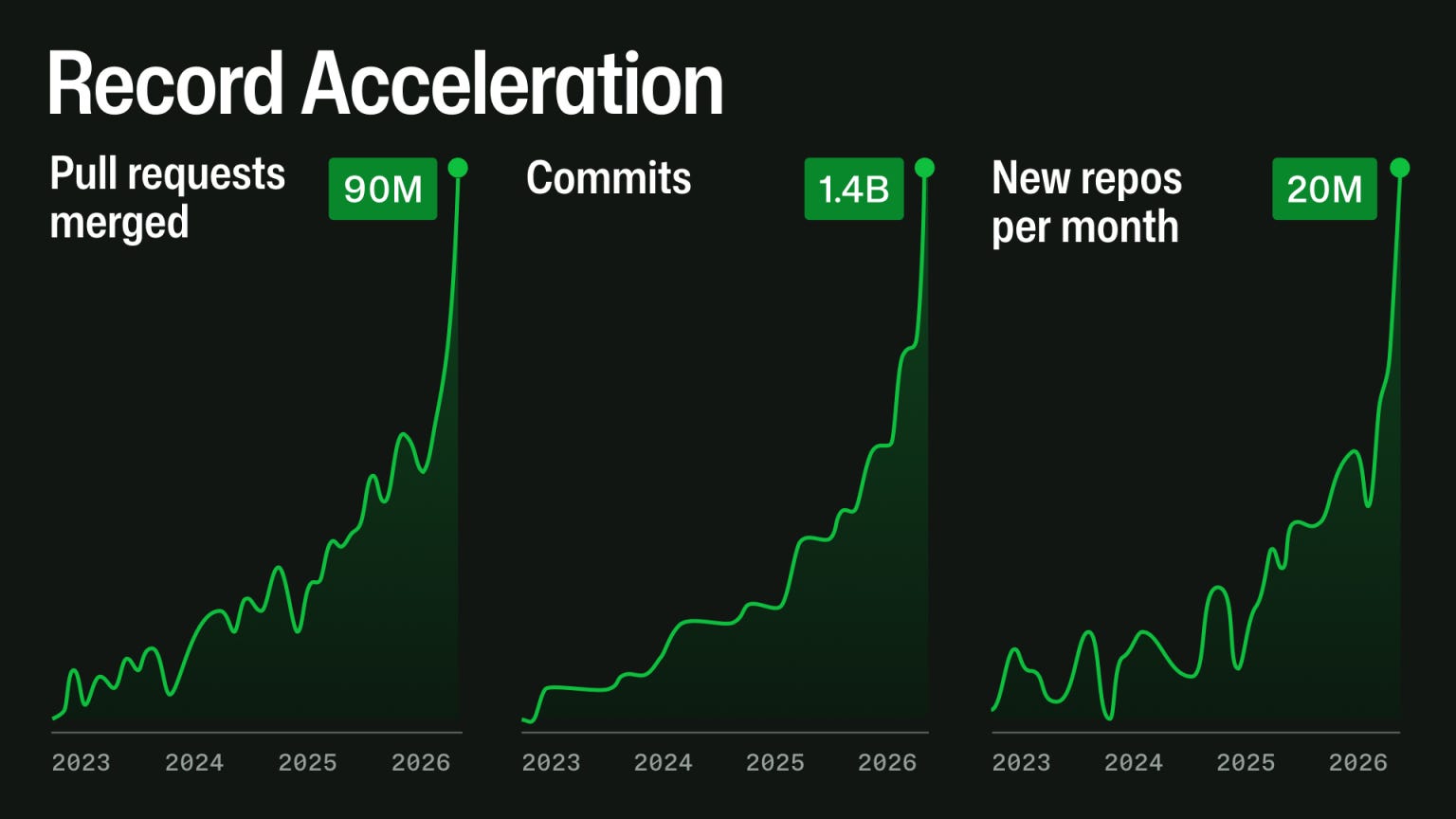
[source: GitHub]
Another interesting element to this, but far more mushy than stat-driven, so bear with me, is politics. In 2018, Microsoft bought GitHub. In 2025, GitHub was officially moved under Microsoft’s CoreAI business, the CEO left and was never replaced.
Not replacing a CEO is a classic corporate‑politics signal: It reduces GitHub’s ability to make decisions on its own and puts it on an equal‑or‑lower footing with other teams inside Microsoft. Battles over control and general malaise set in.
So now, this all appears on customers' doorstep. The brand, the promise that code lives here, reliably, always — is eroding. Stress-tested by AI load, a huge influx of new users (like designers), Microsoft's politics, and a CEO-shaped hole at the top.
Which leaves one thing clear. This brand has work to do.

ChatGPT and fake Monets
ChatGPT Images 2.0 has arrived, and it’s quite a step change.
But don’t worry, AI slop is here to stay.
But this release brings real improvements for designers: better text rendering, denser compositions, and stronger preservation of fine detail.
Still, as these models get better, people remain surprisingly confident they can tell real from fake. Take this Monet posted by concept artist @schl0ms.
He asked people to explain why his AI depiction was inferior to the real thing. Detailed replies poured in, 6M views. The catch was the image wasn’t AI, but rather a screenshot of a lesser-known Monet, a real one.


The replies to this post dissected brushwork and palette choices. Users circled clear "telltale" AI artifacts in the composition.
“I'm disappointed I have to even point it out. There is no cohesion to the depth and color choices.”
These tools will continue to fool and and blur the lines between fake and real.

Design Engineer Fellowship
Design Engineering has gone from a rather niche skillset. To a well sought after seat for EPD (Eng, Product, Design) teams. It’s absolutely still a niche role, but I was taken aback recently when I met a Design recruiter that only looks for Design Eng candidates.
Right now those roles typically split into two archetypes:
1. The “brand” design engineer, who works on more visual web surfaces like marketing sites and landing pages. Often a stronger Graphic Designer.
2. The “product” design engineer, who works in the weeds on product with EPD teams. Often a stronger Front-end Engineer.
Here’s a recent job description from Ramp, for a design engineer.
If this space is exciting to you, the linked fellowship might be as well.
There’s an impressive list of industry leaders who’ll be joining. OpenAI, Stripe, Google Labs, Vercel, Figma and more.
Web Watch
.
GT Mechanik
A dynamic, engaging storefront for a beautifully crafted typeface.

Field Notes
Things I noticed, attended, worked on, and found worth passing on.
.
Shopify Design hosted Design.md and Demo Night 2, Double Diamond also held their first demo night, where my colleague Cam presented. Eric Hu spoke at Pentagram, my old boss Nadia Lung spoke at 1st Round. Figma released their 2026 Config agenda, who’s coming? Tech Week is soon.
.
Karri Saarinen reminds us to be sensible about AI, Scott Galloway wrote “The AI jobs narrative is BS”. Jasmine Sun wrote a popular “underclass” piece and included a behind the scenes on the art direction. Coinbase announced layoffs and the stock dropped, not popped.
.
Jared Palmer moved from GitHub to Xbox. Carl Rivera, head of Design at Shopify moved to Nubank. Thomas Wilder left Wolff Olins to start Reunion Studio.
.
Sam Altman and Mira Murati’s texts leaked “Yes for you to be gone”. Charlie Gearside launched Build Australia. Cosmos relaunched with a spot featuring Odessa A’zion. Are.na launched an image frame that quickly sold out.
.
I tried out Figma Weave and read through Julia Zhuo’s The Making of a Manager and added Sibling Rivalry and Studio Addition to my radar.
Cursor launched an SDK, and 3 blog posts I worked on Autoinstall, Model capabilities and App stability posted. Dan Hollick and Luke Barker were hired to join us on the brand team.
.